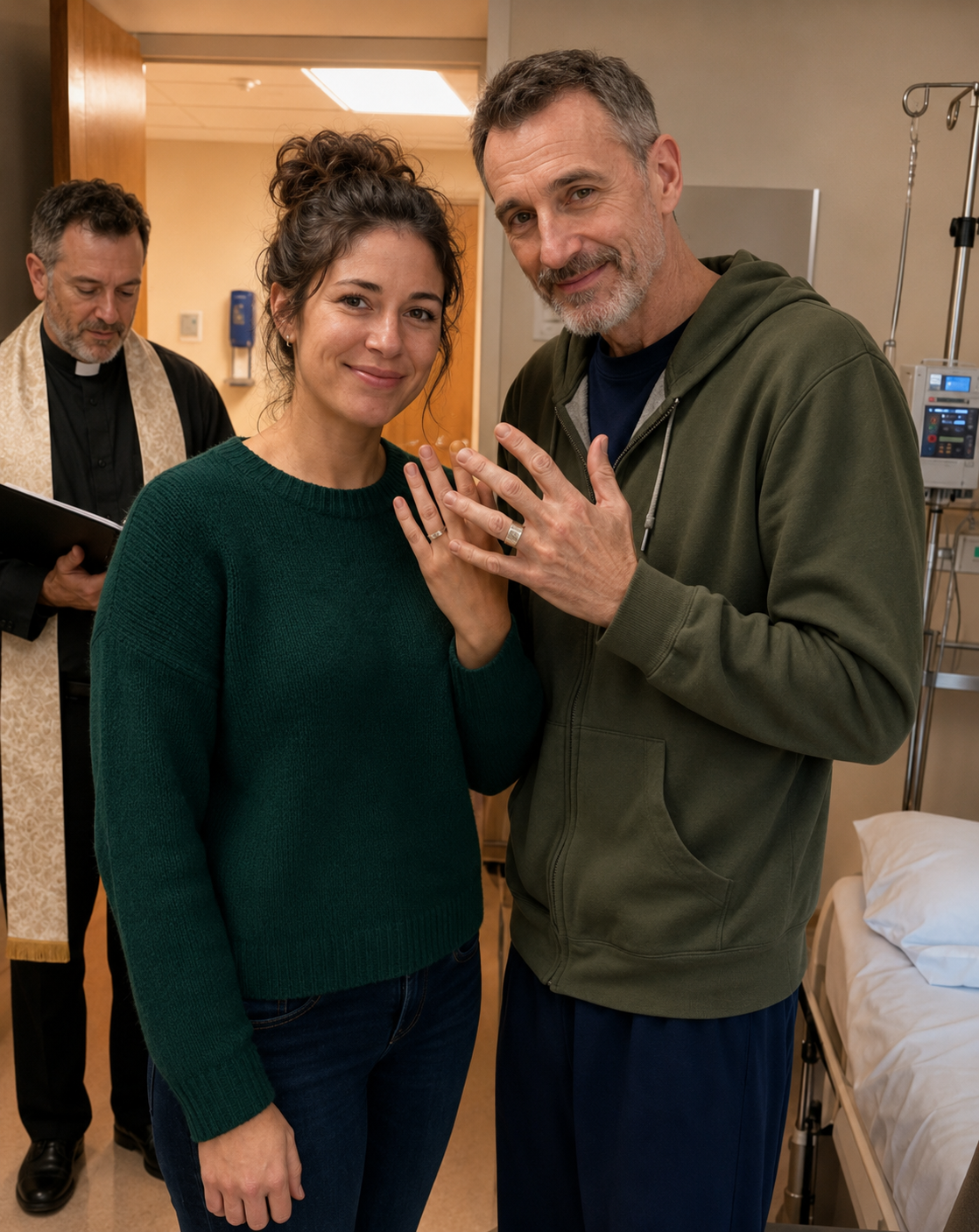
For most people, marrying a stranger would sound unbelievable. For me, it happened inside a quiet hospital room where the machines hummed softly and every day felt borrowed. Thomas was dying, and I couldn’t bear the thought of him leaving the world believing no one had chosen to stay. I expected our brief marriage to end with memories and heartbreak. I never imagined that after only seven days as his wife, his attorney would hand me an old green backpack filled with ordinary places that would completely change how I understood love, grief, and the man I had barely begun to know.
The attorney waited until the nurses had finished preparing Thomas’s room.
The hospital bed was empty now.
His favorite peppermint tea still rested on the tray beside the window, untouched.
The pillow still carried the faint impression of where his head had rested only hours earlier.
Everything looked as though he might return at any moment.
Only he never would.
The lawyer gently lifted an old green backpack from the chair beside the bed.
“Thomas wanted you to have this.”
I frowned.
“What’s inside?”
He hesitated before answering.
“He said you’d understand the truth if you opened it alone.”
“The truth?”
His expression softened.
“Thomas wasn’t exactly who you believed he was.”
Before I could ask another question, he quietly left the room.
That was exactly the kind of thing Thomas would have done.
He never forced answers onto people.
He simply placed them nearby and trusted them to find their own way.
I looked down at the backpack resting in my lap.
It was faded from years of use.
One zipper had been repaired with blue thread.
The shoulder straps had clearly been sewn back together more than once.
Inside, I expected legal documents.
Maybe family photographs.
Perhaps even a letter explaining why he’d asked a woman twenty-nine years younger than him to become his wife.
Instead…
I found dozens of envelopes.
Every single one carried the name of an ordinary place.
Bus Stop.
Airport.
Grocery Store.
Park Bench.
Waiting Room.
Hospital Chapel.
Laundromat.
At the very bottom rested a worn notebook with bent corners.
For some reason…
The envelopes fascinated me far more.
I reached for the first one.
Bus Stop.
Inside lay an old bus ticket.
Nothing else.
Except a short sentence written neatly across the back.
She finally left.
I stared at the words.
Who?
Where?
Why keep a bus ticket for years?
None of it made sense.
I opened another envelope.
Grocery Store.
Inside was a faded receipt for tomato soup, bread, and bottled water.
On the back Thomas had written,
She accepted the soup.
Another envelope.
Park Bench.
Inside rested an old Polaroid photograph.
Thomas sat beside an elderly man wearing a brown coat.
Neither looked at the camera.
Both stared quietly toward something outside the frame.
Across the back…
He smiled before I left.
The more envelopes I opened…
The less I understood.
A child’s crayon drawing.
A napkin with a crossed-out phone number.
A coffee receipt.
Nothing seemed connected.
Each item felt like one missing page from dozens of different stories.
Eventually I reached an envelope labeled…
Waiting Room.
Inside was a hospital visitor badge.
Almost a year old.
The handwriting on the back made my entire body freeze.
She said her mother laughed like she was trying not to.
I couldn’t breathe.
That was me.
The first conversation Thomas and I had ever shared.
Not about death.
Not about illness.
Not about cancer.
He’d simply asked,
“What did your mother’s laugh sound like?”
I’d answered through tears.
“Like she was trying not to.”
He’d smiled gently.
“Those are the best kinds.”
Until that moment…
I’d never realized he’d remembered every word.
I first met Thomas after my mother died.
I had been volunteering at the hospital.
People often praised me for helping lonely patients.
They were wrong.
I wasn’t generous.
I was hiding.
After losing my mother, grief followed me everywhere.
The hospital became the only place where sadness felt normal instead of something people expected me to overcome.
I brought patients water.
Read magazines aloud.
Sat beside strangers whose families never visited.
Some simply wanted someone nearby.
Others wanted silence.
I learned both were forms of comfort.
Thomas seemed different from every other patient.
He never complained.
Never talked about dying.
Instead…
He noticed everyone else.
He remembered the cafeteria worker’s grandson taking his driving test.
He remembered which nurse collected antique postcards.
He remembered a housekeeper’s favorite song because she’d once mentioned her mother loved it.
One afternoon I laughed.
“How do you remember all these people?”
He shrugged.
“I pay attention.”
That was all he said.
At the time…
I thought it was simply kindness.
I didn’t realize it was the way he lived.
Four days after we met…
Thomas quietly asked me to marry him.
I honestly believed he was joking.
“Thomas…”
He smiled weakly.
“I know how strange it sounds.”
“We barely know each other.”
“I know enough.”
“Enough?”
He nodded.
“I know you’re someone who stays.”
Those words stayed with me long after he spoke them.
Two days later…
A hospital chaplain married us inside Thomas’s room.
I wore a yellow sweater because Thomas insisted hospitals needed brighter colors.
He wore his old gray cardigan with the missing button.
When the chaplain asked for rings…
Thomas smiled.
Then carefully removed the pull tab from his soda can.
He slipped it onto my finger.
It was far too large.
He laughed softly.
“We’ll pretend your finger is simply too shy.”
For seven short days…
I became Thomas’s wife.
I adjusted his blankets.
Brought him proper tea instead of hospital coffee.
Sat beside him whenever pain made sleeping impossible.
Near the end, he opened his eyes one final time.
“Sarah…”
“Yes?”
“Don’t mistake stillness for peace.”
I frowned.
“What does that mean?”
His smile barely moved.
“You’ll understand.”
Those were the last words he ever spoke to me.
Now…
The backpack rested beside me.
Filled with places that somehow carried pieces of lives.
Including mine.
I still didn’t understand what Thomas wanted me to discover.
But I knew one thing.
The answers were somewhere inside those ordinary envelopes.
I took the backpack home that evening.
For almost two hours, it sat untouched in the middle of my kitchen table while I wandered from room to room pretending I wasn’t afraid to open it again.
The apartment felt unbearably quiet.
My mother’s favorite mug still rested beside the sink exactly where she’d left it months before she died.
I had never moved it.
Every time I thought about putting it away, something inside me whispered,
“Not yet.”
Near midnight, I finally sat down.
The backpack waited in front of me like a puzzle that refused to explain itself.
I picked another envelope.
Airport.
Inside was an old boarding pass.
Across the back Thomas had written only one sentence.
He finally called his daughter before boarding.
Nothing else.
No names.
No explanation.
Just another unfinished story.
Next came Laundromat.
Inside rested a neatly folded dryer sheet.
The handwriting on the back read,
She said the blanket still smelled like home.
I smiled sadly.
Whoever she was…
Thomas had remembered one sentence that mattered.
Another envelope.
Hospital Chapel.
A small prayer card slipped into my hand.
On the back…
He stopped apologizing for crying.
I slowly spread everything across my table.
Bus Stop.
Airport.
Park Bench.
Grocery Store.
Waiting Room.
Laundromat.
Hospital Chapel.
Ordinary places.
Ordinary objects.
Yet every one of them seemed connected by something invisible.
By dawn I’d slept less than an hour.
Only one thing remained unopened.
The battered notebook.
I carefully lifted it from the bottom of the backpack.
The cover was worn smooth from years of handling.
When I opened the first page, there wasn’t a diary.
No life story.
No confession.
Only two handwritten sentences.
People believe loneliness means having nobody nearby.
Most of the time, it simply means nobody truly notices you’re there.
I stared at those words for several minutes.
Then I turned the page.
Instead of chapters…
There were observations.
Short moments.
Small encounters.
No dates.
No names.
Just people.
One page read:
A young father stood outside the maternity ward checking his watch every thirty seconds.
He wasn’t worried about the time.
He was trying not to cry in front of his own father.
At the bottom Thomas had written:
He hugged him before leaving.
Another page.
An elderly woman stood in front of canned soup for nearly twenty minutes.
She wasn’t deciding what to buy.
She was wondering whether anyone would notice if she stopped coming altogether.
At the bottom:
She accepted the soup.
My breath caught.
That matched one of the envelopes.
Another page.
A teenage boy sat alone at a bus stop.
He let three buses leave without him.
When I asked whether he was waiting for someone, he smiled and said no.
He simply wasn’t ready to go home.
At the bottom…
He boarded the fourth bus.
I kept reading.
A veteran sitting alone on a park bench.
A widow eating breakfast without touching her food.
A frightened little girl refusing to enter an intensive care room because she didn’t want to remember her grandfather connected to machines.
Every story ended the same way.
Not with miracles.
Not with dramatic speeches.
Just…
One tiny step forward.
She laughed.
He called his brother.
She walked inside.
He stayed.
I slowly realized something.
Thomas hadn’t been collecting places.
He’d been collecting moments.
Tiny moments when people quietly chose not to give up.
And somehow…
He always noticed them.
I leaned back in my chair.
Suddenly dozens of conversations I’d shared with Thomas returned all at once.
The cafeteria worker whose husband had started baking bread after retirement.
The volunteer whose grandson had finally earned his driver’s license.
The nervous husband pacing outside surgery.
Thomas remembered every single detail.
One afternoon I’d asked him,
“How do you possibly remember all these people?”
He smiled.
“I don’t try to remember everyone.”
I frowned.
“But you clearly do.”
He looked out the hospital window.
“I just listen carefully while they’re talking.”
At the time…
I thought he was simply being modest.
Now…
I understood.
Listening had been his way of loving people.
Every page inside that notebook proved it.
I finally understood why the backpack contained ordinary places instead of extraordinary ones.
Thomas wasn’t interested in life’s biggest moments.
He believed the smallest ones were the ones people forgot.
And perhaps…
The ones that mattered most.
Several days later I returned to Mr. Aldridge’s office carrying the green backpack with me.
He smiled gently.
“You finished the notebook.”
I nodded.
“But I still don’t understand something.”
“What?”
I looked down at the worn cover.
“Why did Thomas ask me to marry him?”
The attorney remained silent for a long moment.
Then he quietly asked,
“What did Thomas ever ask you for?”
I thought carefully.
Money?
Never.
More time?
Never.
Promises?
Never.
Finally I whispered,
“Nothing.”
The attorney smiled.
“Exactly.”
He opened a file drawer.
Inside was an old newspaper clipping.
When he placed it on the desk, I immediately recognized Thomas.
Only he looked much younger.
Beneath the photograph, one headline read:
Local Grief Counselor Retires After Forty Years of Service.
I looked up in complete disbelief.
“Thomas was a grief counselor?”
The attorney nodded.
“For most of his life.”
“He never told me.”
“He almost never told anyone.”
I stared at the article again.
Suddenly…
Everything about Thomas finally began making sense.
I stared at the newspaper clipping for a long time.
The smiling man in the photograph looked healthier, younger, and full of quiet confidence.
It was Thomas.
The headline read:
Local Grief Counselor Retires After Forty Years of Service.
I looked back at the attorney.
“He spent forty years helping grieving families?”
The attorney nodded.
“Thousands of them.”
“He believed grief wasn’t something to cure.”
“He believed it was something people should never carry alone.”
Everything suddenly made sense.
The notebook.
The envelopes.
The endless conversations Thomas remembered in perfect detail.
He had spent his entire life paying attention to people everyone else overlooked.
“He never mentioned any of this.”
The attorney smiled softly.
“He almost never did.”
“He believed people listened differently when they weren’t being treated.”
I laughed quietly through my tears.
“That sounds exactly like him.”
The attorney reached into another drawer.
“I almost forgot.”
He placed one final sealed envelope on the desk.
Across the front, Thomas had written only two words.
After Tuesday.
I frowned.
“What happens Tuesday?”
The attorney smiled.
“Nothing anymore.”
“What do you mean?”
“Thomas asked me not to give you this until after his funeral.”
He slid the envelope toward me.
“I think he wanted you to understand the notebook first.”
I slipped the envelope into my bag.
“I’ll read it at home.”
“I think that’s exactly what he hoped.”
Instead of driving straight home, I stopped at the small park across from my apartment.
It was the same park Thomas used to watch through the hospital window.
Children chased pigeons across the grass.
A young couple argued cheerfully over directions.
An elderly man sat alone feeding squirrels.
For the first time…
I noticed everyone.
Exactly the way Thomas always had.
I sat on a quiet bench beneath an old maple tree.
Then I carefully opened the final envelope.
Inside wasn’t a letter.
Only a folded notebook page.
I unfolded it.
It contained a list.
Nothing more.
Botanical Garden.
Farmer’s Market.
Buy vanilla ice cream on Oakridge Street.
Feed the ducks—even if they ignore you.
I laughed despite the tears already filling my eyes.
Trust Thomas to leave me a list instead of a speech.
At the bottom he’d written one final sentence.
Ordinary Tuesdays are where life quietly hides.
I looked around the park.
Life hadn’t stopped.
Only I had.
After my mother’s death…
I’d convinced myself everything meaningful had ended.
Thomas had spent seven days quietly proving the opposite.
The following Tuesday…
I decided to follow every item on his list.
First came the botanical garden.
I wandered for almost two hours without checking my phone once.
I noticed flowers I’d normally walk past.
Children trying to catch butterflies.
An elderly couple holding hands without saying a word.
Next…
The farmer’s market.
I bought fresh peaches even though I already had fruit at home.
The woman selling them smiled.
“These are the sweetest ones today.”
Normally I would’ve nodded politely.
Instead…
I stayed.
We talked for almost ten minutes about gardening.
It felt strangely wonderful.
Later I drove to the little ice cream stand on Oakridge Street.
“One vanilla cone,” I ordered.
The teenage cashier smiled.
“Good choice.”
As I walked toward the lake, I suddenly laughed.
Thomas had remembered my favorite flavor.
I had never told him.
At least…
I didn’t think I had.
Then I remembered.
Weeks earlier, while walking past the hospital gift shop, I’d stared at the freezer for several seconds.
Thomas had smiled.
“If you could have anything right now…”
“…what would it be?”
“Vanilla ice cream.”
He’d nodded.
Nothing more.
Of course he’d remembered.
Finally…
I reached the lake.
I scattered breadcrumbs exactly as his note instructed.
The ducks completely ignored me.
I burst into laughter.
People turned to stare.
For once…
I didn’t care.
Driving home, I realized something unexpected.
For the first time since losing my mother…
I wasn’t thinking about grief every minute.
I was thinking about living.
Months passed.
I never became someone who magically stopped missing people.
Thomas would’ve said that wasn’t the goal anyway.
Instead…
I started paying attention.
Really paying attention.
I learned the cashier at my neighborhood grocery store was taking evening nursing classes.
I remembered my mail carrier’s birthday after he casually mentioned it once.
I noticed when my elderly neighbor stopped opening her curtains every morning.
Instead of assuming she wanted privacy…
I knocked.
She’d fallen the night before.
She smiled through tears when she saw me.
“I didn’t know who else to call.”
Neither had the young father outside the delivery room.
Or the woman buying tomato soup.
Or the teenager at the bus stop.
Thomas had taught me something extraordinary through the most ordinary moments.
Sometimes people aren’t asking to have their lives fixed.
They’re simply hoping someone notices they’re carrying something heavy.
One year after Thomas died, I returned to the hospital where we’d met.
The volunteer coordinator smiled when she saw me.
“Back already?”
I nodded.
“I think I finally understand why I came here the first time.”
“And why was that?”
I looked down the familiar hallway.
Rows of patients.
Families waiting.
Nurses hurrying from room to room.
“Because grief brought me here.”
She smiled.
“And now?”
I smiled back.
“Now compassion keeps me here.”
That afternoon I slipped Thomas’s green backpack over my shoulder before beginning my volunteer shift.
It no longer felt like something left behind by a dying man.
It felt like a reminder.
To notice.
To listen.
To stay.
Because sometimes the greatest gift we can give another person isn’t solving their pain.
It’s making sure they never have to carry it believing nobody sees them.